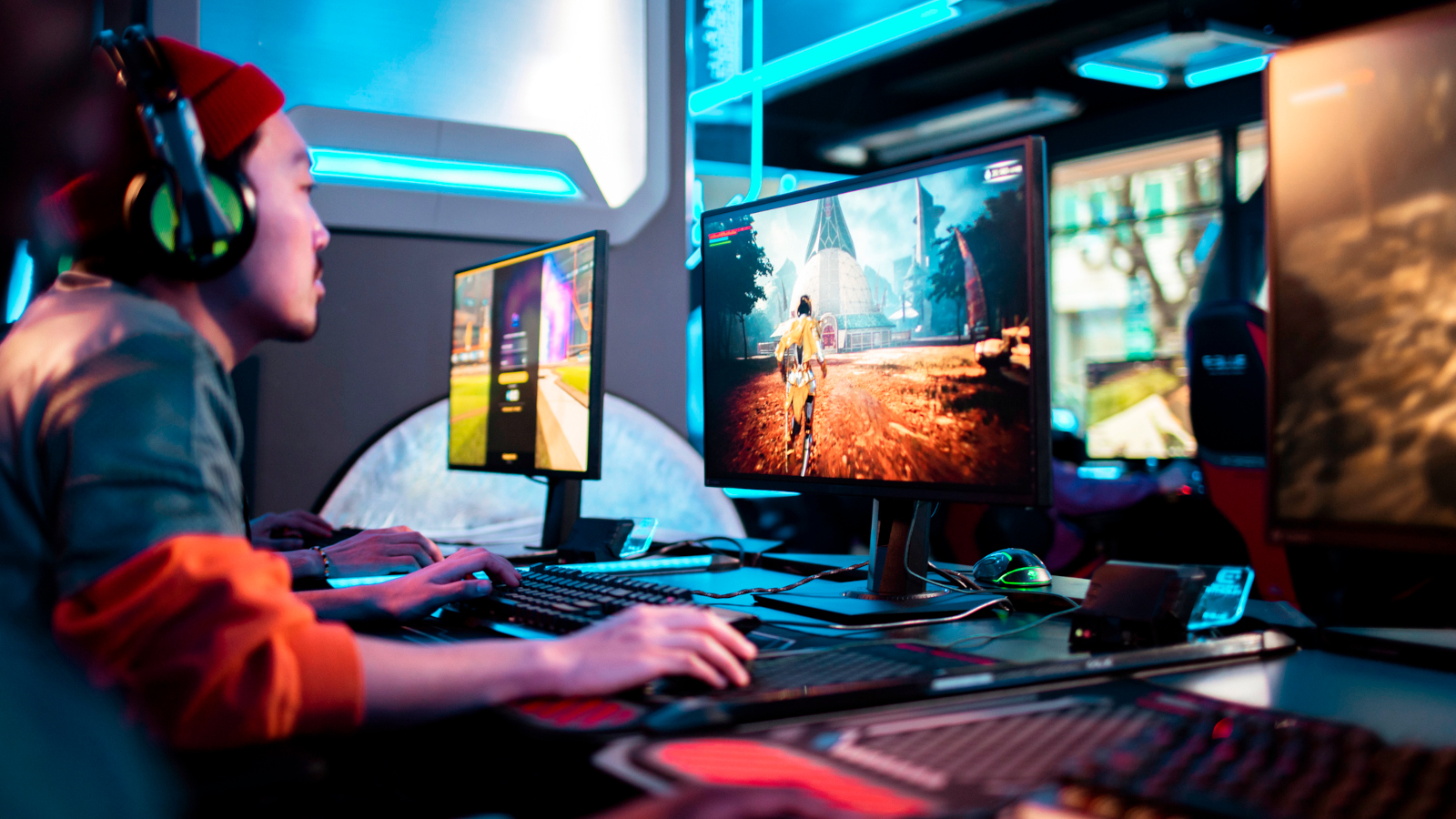
For most of gaming's first three decades, playing a game was a private or at most a shared-sofa activity. You played alone, or with someone physically beside you. The world your game created was contained within the screen in front of you, and when you turned it off, that world ceased to exist.
The internet changed all of that, and the change was much more profound than simply letting players compete with strangers. It altered the social fabric of gaming entirely. It created communities, careers, languages and cultures that have outlasted many of the specific games that spawned them. It made gaming, in ways both obvious and subtle, into something that looks a great deal like participation in a shared ongoing story.
The Early Online Pioneers
Online gaming didn't begin with broadband. Early experiments with networked play date to the 1970s and 1980s, when university students were connecting terminals to share computing resources. Text-based games called MUDs (Multi-User Dungeons) created persistent shared worlds as early as 1978. Players could explore, interact and leave their mark on an environment that existed between sessions — a concept that seems mundane now but was genuinely revolutionary at the time.
Through the late 1980s and most of the 1990s, online gaming on the PC was a niche activity constrained by slow dial-up connections, expensive phone bills and the technical literacy required to connect at all. Games like Ultima Online, launched in 1997, pushed through those barriers to create the first commercially successful massively multiplayer online world. The subscription model — players paying a monthly fee for continued access — established a commercial framework that would sustain online games for decades.
Quake and the Birth of Online Competition
Alongside persistent virtual worlds, a different kind of online gaming was taking shape. Quake, released in 1996 by id Software, was built from the ground up to support fast-paced multiplayer over networks. It was designed to be played against other humans, and the experience of doing so — the unpredictability, the communication, the emerging strategies — was qualitatively different from anything AI opponents could offer.
Quake tournaments began appearing almost immediately after the game's release. The first notable large-scale tournament, Red Annihilation, was held in 1997 and attracted over 2,000 online participants. The winner, Dennis Fong, received John Carmack's Ferrari. That event is often cited as an early marker of what competitive gaming could become — though nobody at the time could have predicted how far it would eventually go.
World of Warcraft and the MMO Peak
If Ultima Online and EverQuest established the formula, World of Warcraft refined it into something that reached a scale its predecessors could barely have imagined. Launched in November 2004, WoW became a genuine cultural phenomenon, peaking at around 12 million subscribers in 2010 — a number that translated to roughly $1.4 billion in annual revenue from subscriptions alone.
What WoW achieved wasn't just commercial. It created a social infrastructure. Guilds became meaningful communities. People formed genuine friendships, some of which outlasted their time in the game by many years. Couples met in Azeroth. Groups of people who had never shared a physical space learned to coordinate, communicate and trust each other in pursuit of a shared goal — whether that goal was clearing a difficult dungeon or simply exploring the world together.
The psychological mechanisms that made this work are worth understanding. Shared challenge creates solidarity. Persistent character progression gives players a stake in continued engagement. Community norms — even in a fictional context — create genuine social bonds. WoW wasn't just a game. It was, for many of its players, a meaningful social space.
Console Online and the Xbox Live Effect
While PC gaming had been online for years, console gaming arrived at the party later but with enormous impact. Xbox Live launched in November 2002 with Halo 2 as its flagship title. The service was well-designed, easy to use and — crucially — it worked reliably. For console players who had previously needed a LAN setup to play with friends, the ability to connect instantly with players worldwide felt transformative.
Call of Duty 4: Modern Warfare in 2007 is frequently cited as the moment online console gaming became genuinely mainstream. Its progressive unlock system, experience points and class customisation gave players a sense of growth and investment that kept them returning. The model it established — online multiplayer with progression systems — became the template for virtually every major shooter that followed.
Streaming, Content Creation and the New Spectator Culture
For much of gaming's history, watching someone else play was considered a poor substitute for playing yourself. That assumption began to erode with the rise of YouTube gaming content and was overturned entirely by Twitch, which launched in 2011.
Streaming turned gaming into a spectator activity with genuine cultural weight. Millions of people now watch games being played without any particular desire to play themselves — because the personality of the streamer, the community in the chat, or simply the entertainment value of skilled play is compelling enough on its own. The most popular streamers have audiences that dwarf traditional media properties.
This created an entirely new professional category. Content creators who built audiences through skill, personality or comedy became viable careers. The relationship between games and the people who play them professionally became commercial and public in ways that would have seemed entirely implausible twenty years earlier.
Communities: The Unofficial Architecture of Gaming
Beyond streaming and competition, online gaming produced something harder to quantify but arguably more significant: communities. Forums, Discord servers, subreddits, wikis, fan art communities, speedrunning groups — gaming generated an ecosystem of social organisation that is genuinely impressive in its complexity and diversity.
These communities often outlast the games that created them. There are active communities dedicated to games that are decades old, maintained by enthusiasts who create mods, organise events and document history that would otherwise be lost. The preservation of gaming culture has, in large part, been driven by these communities rather than by the original publishers.
There's also a darker dimension to online gaming communities that it would be dishonest to ignore. Anonymity, competitive pressure and the relative immaturity of community moderation tools have contributed to toxicity problems in many online spaces. The question of how to build and maintain healthy gaming communities is one the industry continues to grapple with — and there are no simple answers.
What Comes Next
Online gaming has become so fundamental to the medium that it's difficult now to imagine a gaming landscape without it. Even games that are primarily single-player have online components — leaderboards, social sharing, asynchronous multiplayer features. The boundaries between online and offline have largely dissolved.
The next evolution is already visible. Cloud gaming promises to decouple gaming from dedicated hardware. Social gaming spaces are evolving toward something that some describe as the metaverse — persistent shared digital environments that are not tied to a specific game. AI-driven companions and opponents are becoming sophisticated enough to provide genuinely social-feeling experiences.
What won't change is the fundamental reason people are drawn to online gaming in the first place. The appeal is not the technology — it's the connection. Playing with and against other people, sharing experiences and stories, belonging to communities built around something you care about. That desire is old and human, and no technology change will make it obsolete.